
If you are looking for the meaning of a SKU number, the short answer is simple: a SKU (stock keeping unit) is an internal code a business creates to identify a specific product or product variant in its own inventory.
A SKU might identify a black T-shirt in size M, while another SKU identifies the same T-shirt in size L. The code does not have to follow a universal format, and two different retailers can use completely different SKUs for the same physical product.
What does a SKU number mean?
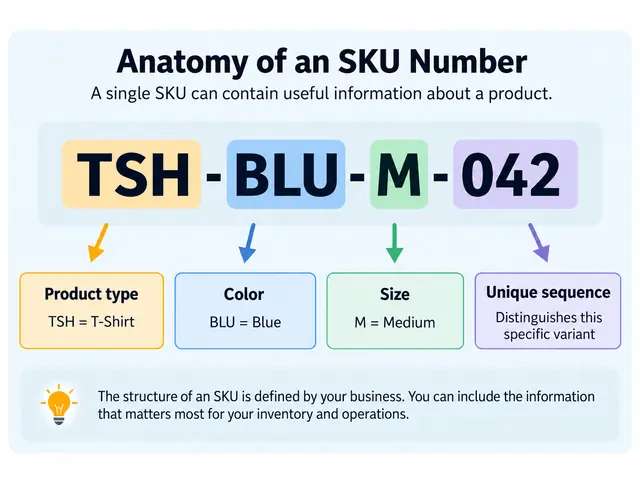
SKU stands for stock keeping unit. In practice, the term can refer to both the individual stock item and the code used to identify it.
Businesses use SKU numbers to distinguish products that may look almost identical but must be tracked separately. Color, size, model, material, pack quantity, supplier or product family can all be represented in the code.
For example:
TSH-BLU-M-042
| Part | Meaning |
|---|---|
| TSH | T-shirt |
| BLU | Blue |
| M | Medium |
| 042 | Unique sequence |
There is no rule saying a SKU must use this exact structure. The important point is that the structure is consistent inside your business.
Is a SKU a product number?
A SKU is a type of product identifier, but it is usually an internal product number rather than a universal one.
If your business creates the code CHR-BLK-01 for a black office chair, another retailer can use a completely different SKU for the same chair. Your SKU only needs to be unique within the system where you use it.
That makes SKUs useful for inventory records, picking, stock counts, purchasing and reporting. Instead of relying on a product name such as “Classic Chair – Black,” the system can use one exact code everywhere.
One product can have several SKUs
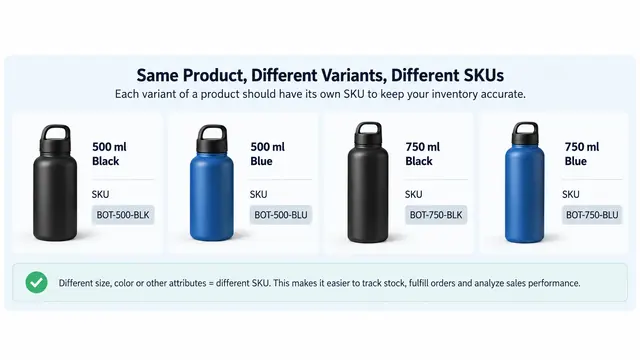
Suppose a store sells the same water bottle in three colors and two sizes. That creates six inventory variants, so each variant should have its own SKU.
| Product variant | Example SKU |
|---|---|
| 500 ml, black | BOT-500-BLK |
| 500 ml, blue | BOT-500-BLU |
| 500 ml, green | BOT-500-GRN |
| 750 ml, black | BOT-750-BLK |
| 750 ml, blue | BOT-750-BLU |
| 750 ml, green | BOT-750-GRN |
This is the main idea behind a SKU system: each stock-tracked variant gets an identifier that removes ambiguity.
A SKU does not have to describe every characteristic. If adding material, supplier, year and warehouse zone makes the code difficult to read, keep those details in separate product fields instead.
How a SKU differs from other identifiers
SKUs, barcodes and serial numbers are often mentioned together, but they serve different purposes.
| Identifier | What it identifies | Created or controlled by | Typical scope |
|---|---|---|---|
| SKU | A product or variant | The business using it | Internal |
| UPC/GTIN | A standardized trade item | GS1-based identification system | Cross-company |
| Barcode | A machine-readable representation of data | Depends on the encoded value | Internal or external |
| Serial number | One individual physical unit | Manufacturer or business | One unit |
A barcode is therefore not automatically a SKU. A barcode can encode a SKU, a standardized product identifier, a warehouse location or another value.
For internal product labels, you can turn an SKU into a scannable Code 128 barcode with WareStat’s free Barcode & QR Code Generator.
Where do you find a SKU number?
There is no single universal place because SKUs are managed by the business that creates them.
You may find an SKU in:
- an inventory management system;
- an ecommerce product record;
- a warehouse or shelf label;
- a price tag;
- a packing slip or internal order document;
- a product spreadsheet.
A customer-facing package may show a standardized barcode while the retailer’s own SKU exists only in its internal software. That is normal because the two identifiers solve different problems.
How to create a useful SKU number
A good SKU system should be easy to read, unique and stable. It does not need to be complicated.
A practical structure is:
CATEGORY-VARIANT-SEQUENCE
For example:
MUG-WHT-025
or, when size matters:
TSH-GRN-L-118
When creating SKUs, use a few rules consistently:
- give every stock-tracked variant its own SKU;
- use the same abbreviations throughout the catalog;
- avoid spaces and unusual symbols that may cause problems when importing or exporting data;
- do not make the code longer than necessary;
- do not reuse an old SKU for a different product;
- keep information likely to change, such as price or warehouse bin, out of the SKU itself.
The last rule matters because a SKU should normally stay attached to the same product even when its price, supplier or storage location changes.
What a SKU number should not contain
A common mistake is trying to turn a SKU into a miniature database record.
Consider this code:
SUP1-CHAIR-BLACK-LARGE-WH2-A12-2026-049
It may look informative, but it becomes fragile. If the chair moves to another warehouse or the supplier changes, part of the SKU becomes incorrect.
A shorter identifier such as CHR-BLK-L-049 is easier to maintain. Supplier, location, cost and reorder level can remain separate fields in the inventory system.
This separation also makes SKU-level analysis cleaner. Once each variant has a stable identifier, stock levels and product movements can be compared without changing the identifier whenever operational details change.
Why the SKU matters in inventory management
The real meaning of a SKU is not hidden in the letters themselves. Its value comes from consistency.
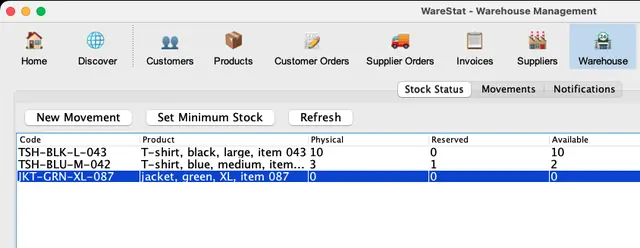
A SKU gives one product variant one stable identity. Inventory software can then connect that identity to quantity on hand, reserved stock, purchase orders, sales, costs and other records.
For example, WareStat can track stock levels for individual products while keeping quantities, minimum-stock thresholds and inventory status connected to the corresponding product record.
That is why a simple SKU such as CAB-USB-C-2M-014 can be more useful than a long product description. The description can change; the SKU remains the reference used to find the same inventory item.
Does every product need a SKU?
If a product or variant is tracked separately in inventory, giving it its own SKU is usually the clearest approach. Very small catalogs can work without a formal SKU structure, but ambiguity increases as the catalog grows.
Can a SKU contain letters?
Yes. SKUs are commonly alphanumeric. Letters often make categories, colors, sizes or product families easier to recognize.
Can two businesses use the same SKU number?
Yes. SKUs are internal identifiers, so two unrelated businesses can independently create the same code. The important requirement is uniqueness within your own inventory system.
Is a SKU the same as a barcode number?
No. A SKU is the identifier itself. A barcode is a machine-readable way to represent data. You can create a barcode that encodes your SKU, but they are not the same thing.